Thursday, June 29, 2006

Of people and perceptions...

I will begin with an experiment.

Let us say you overheard a person say, "all north indians are arrogant"

What would your reactions be?

The reasonable answer to that question is, "it depends..."

right?

My reaction to this would depend on different factors, namely -

1. whether that person is a north indian or a south indian
2. whether I am north indian
3. whether the person making the statement is a stranger to you or not
4. if s/he is not a stranger, whether you have heard his/her previous statements on north indians
5. if s/he is not a stranger and if you never heard that person talk about north indians; whether that person is given to making such bigoted statement.
6. what your own views on north indians are
7. whether you are short tempered, reactive, etc.

Of course, we do not do all these analysis and we directly jump to a reaction. But we cannot deny the influence of these factors in our minds.

For example, if you know that the person who makes this statement is not a bigoted fathead, you would be confused and would try to find out what made that person make such a statement. But if you did not know that person at all, and if you are a north indian, you might just get defensive/annoyed/angry, which would be perfectly legitimate.

So, the reaction to such a statement would be quite contextual. What I am trying to say is that just because you are north indian does not mean that you would not become angry on hearing this statement. right?

There could be several reasons why that person made that statement. It may be because someone said some north indian said something disparaging about his/her ethnic group. Maybe s/he geniunely thinks so. Maybe by saying something as insensitive like that, that person is trying to hold a mirror the insensitivity of someone's statements (by holding up a mirror to that other person, s/he might be trying to show their fallacy in making statements based on stereotypes).

There has been a furore over this post by Annie. She makes certain statements that are pretty ridiculous. People have taken this opportunity to bash her and her statements. On the surface, when taken separately, these statements sound pretty insane and it would be reasonable for one who reads it to assume that whoever said that is a nutjob.

But is Annie really a nutjob?

If one has read Annie's blog regularly, these statements would seem pretty uncharacteristic of her.* She is a feminist, no doubt but not a separatist. Knowledge of her previous posts should ensure that your reaction to such statements to not be indignant. The only reason that you can think of with this pre-knowledge of Annie's writings is that she is attempting to satire someone else's statements. Considering that this post is written as a response to a sexist post by another person, it seems to me that this hypothesis is quite likely.

For a person for whom this is the first post of Annie being encountered, it is quite plausible for that person to think ill of the post and of Annie. But for a regular reader of her blog, is it a reasonable reaction? I do not think so. Which is why I am disappointed with Dilip and others who, though think the post was a good one, denounce these controversial statements.

* Of course, if one reads the whole post properly, one would see that she writes a lot of very sensible and thought provoking that are very characteristic of her.

, , ,

Wednesday, June 28, 2006

He is back....

I mentioned earlier today that I am an atheist.

Well, I do believe in one God. And His name is Roger Federer!

I love the way he plays his tennis. He plays exceptional tennis and what is truly masterful about Him is that He makes it look so easy. He wins wish such an ease that I never thought He could lose ever.

Along came the challenger, Nadal. All that Nadal has been able to do is win against him on clay. And he made Federer look human in the Roland Garros final. I thought Federer was losing his touch and I feared that this was the end of his reign.

But today He showed that he is still the old perfect One. The way he demolished Henman today was poetry in motion. He just played flawless tennis today and I do not think there is any challenge to this year's title too.

What a difference between the game he played today and the one in Roland Garros a couple of weeks ago. He made 8 unforced errors in the entire match, whereas he made more than 15 errors in every set that he lost in the only grand slam final he has ever lost.

, , ,

In the libertarian world, everyone would be equal and the temples would sport the sign, "Right to admission reserved".

--- Me

Inspiration -- this post

, ,

Bresson's Diary of a country priest

DISCLAIMER: This is not a review. What I write here are thoughts provoked by this wonderful filmmaker's film.

Bresson is known to make films that make you think. I saw three of his movies this weekend and I thought that his films do make you think. I found all the three to be extremely engaging and interesting but it was one that really made me think a lot.

Diary of a country priest is exactly what the title suggests it to be. The fim chronicles the thoughts and actions of a country priest who writes it down in his journal every day. It is an exploration of faith, the loss of it and the importance of it in human existence. The film makes you think about religion's role in helping human beings tide survive.

A young priest is handed the control over a local parish who is suffering, as we come to know later in the movie, from stomach cancer. He is new to the job and is extremely apprehensive about his duties. His suffering also make him question his faith and his position as the priest makes him a lonely man. As a priest, he is expected to instill faith in his flock. Since he is the man whose job is to make other people guilty, he is universally hated. As the priest of Torcy says, a priest's job is about power and control, and not about love. This makes it harder for the young suffering priest because he has a childish innocence about him which further alienates him from the others. Why? because as explained in the movie, his innocence makes people aware of their sins. He suffocates them and they respond to it with malicious whispers about him being an alcoholic and having handled the Count's wife in an undesired manner.

Alienation of a person from the society s/he lives in usually drives the person to seek solace in something. Usually, that solace is found in faith and the belief that God is out there looking down on you. Another reason that drives one to God is a long standing suffering of some sort. The priest has got both reasons to turn to God besides being obligated to be a Godman. But his unabated suffering makes him question the almighty which he later regrets and at one point, deletes the blasphemous entries from his journal. But what he said has been said and he cannot take it back.

One of the reasons why atheism is hard is because of the fact that since you believe that there is no God, there is really no one to turn to and there is no way to get rid of the depression you are in. By having blind faith, it gives you the courage to tide over the rough waves of life by simply believing in the notion that God is out there looking at you and when He wil do justice. That He would abate your suffering and make you well after some time. Or He would make sure you got a place in paradise. Religion is the best coping mechanism out there (PSY 101). Religion invents a purpose for life and I think humankind would have long gone crazy wihout such a purpose, invented or otherwise. In fact, I would say that the invention of religion was essential for survival of the species because we think too much. We refuse to just eat, reproduce, defecate and die as a matter of fact. The questioning attitude of the human race is unique to it.

When the hard times hit the atheist, who does s/he turn to? Knowing that there is no God, that the world is just a random sequence of events and is inherently unjust makes it extra hard. It is a luxury to just forget the worries, "put the trust in God", and go about working towards your 'purpose' in life.

What an atheist needs is a different coping mechanism that is as good as religion. Is there really one out there? I do not think so. This is the reason the fear of God is inculcated right from childhood. Children are taught not to question God and the scriptures that define God. This way they are best equipped for the future. Most atheist lose their 'faith' when they are faced with hardships. They resist it but soon are consumed by the need for a faith to survive. Agnostics are too easy to bend towards the 'light of God'.

In the film, the priest has doubts about his faith but after having been able to instill faith in another person and having determined that she died having submitted to God's mercy completely, his doubts are dispelled. Because it is his purpose in life to instill the fear of God in other people.

We also see that the priest does not turn away from a young girl whose heart is full of hatred and malice. This I believe is another purpose of religion. According to words ascribed to Jesus Christ, God forgives a person any number of time. He always forgives when you repent. A priest's job is not to banish the sinners but to make them repent their sins. People come close to losing their faiths a lot of times in their lives. It is the job of the priest to get them back into the fold and make sure that they dont completely lose their faiths.

Why does religion ever become problematic? Because human beings are just so imperfect creatures. Blind faith is incredibly dangerous. Mainly because it means that people would accept anything said by the religious in charge, the priest, the bishop, the archbishop, and finally, the pope. Power corrupts human beings. And people in such religious position have the capability to create dogmas that could have severe repurcussions to the working of the society. The religious heads, no matter whom they claim to serve, are actually trying to extend their influence on more people. Sometimes, they don't even realise that.

Human beings destroy everything. Because that is just what we do. Sad, but true. The trick is to accept this fact without getting consumed by it. To be consumed by it is to become corrupt yourselves and losing your idealism.

Bresson's film captures the loneliness of the priest and the mental tussles he undergoes in a superb fashion. You get emotionally attached to the priest. You suffer as he suffers and you get a rare peek into the cold, alien, distant world of the priests who have to be just that because of the very nature of their jobs.

It is a simple film with extremely complicated ideas behind it. It could probably be contrued to be a catholic film but it would be stupid to do that. And it is a fiml that does make you think about spirituality and religion.

PS. I do _not_ think that God exists
PPS. I am yet to find another coping mechanism but by God's grace, I am also yet to suffer. I have been privileged.

, , , ,

Tuesday, June 27, 2006

Patriarchy and men

A common misconception about feminism is that it is against men. This is not true. Feminism is against patriarchy, which is the hierarchical system that differentiates people into rigid classes and dictates their behaviour according to stereotypes.

Women are affected largely because they are never in the position of power and are always the subservient. Feminism did start as a movement to liberate women from the shackles that patriarchy puts them in. But it was soon realised that women are not the only ones who are put down by patriarchy. Men are too.

One of the stereotypes regarding men is that they are supposed to be inarticulate who never cry and keep their feelings bottled up because to do so would be to be a "sissy" and a "pussy" (misogynist terms). Of course, these restrictions stem from the notion that having feminine qualities (which are attributed to women) is degrading to being a man.

This incredible piece articulates how such a rigid restriction on the concept of being a man can be detrimental to men.

My favourite part of the article was this -

A pivotal moment came about six years ago when, at the end of a long cross-country phone conversation with an old friend, he said, "Karl, I love you." I was knocked off balance. Saying "I love you" to another man? Unthinkable. I could only reply, "That cuts both ways."


Sony Pony explores another, related, way in which men can be affected by patriarchy.

Feminism is still a majorly women's movement because patriarchy affects women in much more insidious, dangerous, fatal manner than men. Statistics suggest that there is an urgent need for a Domestic Violence Bill.

Hat tip - Feministe

,

Thursday, June 22, 2006

A little skit and some explication

This was a small skit I wrote on a friend's blog. Since then, I thought I better explain a bit more about this because I see this as an opportunity to make a point (don't I always?).

1: apple is a fruit that...
2: orange is a fruit too.
1: we are talking about apples.
2: are you saying that orange is not a fruit?
1: Where did oranges come from?
2: from nagpur, you get the best oranges.
1: no, no. I am asking why did you bring them into the conversation?
2: why shouldn't I? can't I express my opinion?
1: but I was talking about apples.
2: and orange is a fruit too...
1: yes, orange is a fruit but...
2: so , you agree. I am right, you are wrong!
1: (sobs incoherntly)

There are times when you feel really frustrated talking to certain individuals (or groups of people) who refuse to stick to the narrow window of the subject of what I am trying to say and bring in points of their own that is totally unrelated to the topic. When you try to bring them back on track, they become hostile and stick to their guns that what they say is valid and I must accept what they say or bring in a counterpoint. If you do try to debate with them on what they decide is the subject of the discussion, your original topic is lost and there is a high chnace that they might jump to something else again. Also, if you end up in a situation where what they say is actually reasonable and you accept it to be so, they would consider the entire argument closed and that there is nothing more to discuss and their opinion on a very broad topic has been accepted.

The thing about these individuals is that they refuse to listen to anything that we say and are so sure of their 'rightness' that there is no room for any other arguments in their minds. They would dismiss it without considering it and even if they are unable to argue against it. And then they jump, much like Battlestar Gallactica that needs to be one step ahead on the cylons. Which is why I become apprehensive about conceding a point to them in any way because they delude themselves into believing that they have managed to convince me of a view contrary to something I began with. And when I refuse to do that, and I try to bring them back to the topic, they become hostile (again) and call me intransigent and other such things.

It is not really a futile thing to argue with such people because when you start arguing with them, you realise how easy is it for your words to be misunderstood and that makes you improve upon what you write, how you present your veiws and what stratergies you adopt to push across some idea. You may never convince them but you might convince others who have not taken sides and who do indeed have an open mind. But having said that, it is hard to not abuse them because they really are morons (couldn't resist).

It is obvious, in the above skit, who represents my point of view. After all, I am the alpha.

, , , ,

Wednesday, June 14, 2006

My old school

Yesterday, I was searching for my old school and I found this news story about it.

The news story talks about the advent of computer classes in the school. Computers weren't around when I was there. For the 11th and 12th standard, the chocies with PCM was Bio or Political Science. I wanted to take Pol Science, which was being taught by a teacher I admired and was also a subject I was interested in, but my parents overruled me there. I regret not having my foot down then. But if computers would have been around, I probably would have taken it, something that I would have regreted later.

Though I did spend just the last three years of my school life there, I think I had some of the best times there.

Friday, June 09, 2006

Multiplicity of views and intolerance

Unlike what some people would have you believe, everything is not black and white. There are a lot of grey areas. In fact, grey areas form the majority. The whiteness or blackness of the grey areas could be a subject of debate. There would be some grey areas which people wont dispute about it being more white than black and vice versa. Of course, there are always some radicals who question that. And there would be some grey areas about which there will always be a dispute regarding its dominant colour (white or black). Considering that there were no objective means to solve this dispute, it really becomes hard to come to a conclusion regarding those grey grey areas. Unless, one group is able to convince all the others, there would be no consensus regarding this issue.

There are many kinds of people in this world.
There are people who refuse to see the grey areas in the world and their dichotomy of the world into black and white is dictated by dogma, religious or others. They are what we would call the fundamentalists, who are so incredibly stubborn that it is quite a stupid thing to even try to explain that it is not that simple. I won't even consider having a conversation with them because it is quite impossible not to feel frustrated while talking to them.
There are those who do believe in the grey areas. They see it and decide how white or black it is. And they form strong opinions about that. So, again the dichotomy appears with such kinds of people. They see the grey but form two opposing camps with exactly opposite opinion about what is the dominant colour in that particular grey. They confront eachother with their opinions and are quite intransigent about them. For both of them, it is obvious which is the dominant colour and they are unable to understand why the people in the other camp are blind to that fact! Both cannot objectively quantize why they feel so about that particular grey area. Their inability to put their perception into words created more frustration. When they do put those perceptions into words, they know that it is imperfect representation and they get attacked for it. Neither camp gets anywhere in trying to convince the other because for both of them there could be no other view regarding which view is the right one.

Intolerance breeds not only in fundamentalists but also in people who refuse to see that human perception is not perfect and what is obvious to one need not be obvious to the other.

In a recent discussion with Falstaff, he mentioned that the dichomtomy of right and wrong works at a very micro level, ie, you can divide any issue into atomic subissues (my grey dots) about which you form an opinion about whether it is right or wrong. And depending on what you think about each sub-issue and how much weightage you give to each of them, you form a opinion about the issue in question.

So, there can be very complex and varied views about the same issue. There would be a mulitplicity of views on any issue and it would be wrong to simplify this complexity into just two opposing camps. But, in general, that is what usually happens. Most of the time, we do not do a self-analysis about what goes into out thought process in coming to a particular conclusion. Most of the times, it is 'obvious that we are right'. The question of why is never answered, because obvious things do not need any explanation. This refusal/inability to analyse their own views and that of others leads to misunderstanding and confrontations that lead nowhere. People who do put forth some logical views and base them on facts are dismissed by the other side using one of several mind-block techniques. One of the most common amongst people is dismissing someone's opinion as being marxist, which basically stems from a misunderstanding of marxism (someday I will write a short introduction about marxist schools of thoughts).

How are such issues resolved? I do not think there is any other way to resolve it than to submit the case/disagreement before an accepted authority like the Supreme Court and accept whatever decision that that authority gives out. Sadly, you cannot question the decision of the court in India because that is punishable as 'contempt of court'. But that is a different issue.

This kind of dependence on one authority to resolve conflicts is not healthy because after all the judges are human. What it leads is to a sense of victory/defeat in the two parties and no real understanding of the other point of view. The best way to resolve this conflict is through dialogue, debate and compromises. What I am suggesting is a form of a participatory democracy where people decide for themselves on issues that concern them. We do not have such a tradition in India and that I think is the bane of Indian democracy.

Blogs have been pretty important in this process of debate because of their numerous advantages. Physical proximity is not an issue. Temporal proximity is also not an issue. So, on blogs and discussion boards, we could very well have a debate that spreads over days and involves people from all over the world. Of course, the disadvantage would be that the online world is elitist and involves people who have access and knowledge. So, it involves a small subset of people and does not have the diversity that is desired.

What have I professed? That we should debate, respect each other views and be more open to opposing views. Of course, there are some who are just plain wrong. For example, read the comments of Falstaff's post. There is a person who goes my the name of MockTurtle who posits the view that rape stems from a 'natural male urge' and he gives the examples of the predominance of rape in the animal world. What I find amusing is that he seems to say that sexual urges cannot be controlled sometimes and that they can be quite overwhelming. I wonder whether he poops and pisses in his pants because isn't that what animals do. They poop wherever they want, whenever they want. His argument is just plain wrong. I could never respect his views nor come to a compromise with this person. And if some judge ruled in his favour, I would probably be jailed for contempt of court.

It is not just in views that people differ. They may agree that there is a problem but may disagree with the methodologies adopted for rectifying this problem. They would have different but strong opinions about what may or may not be the 'right' way to go about changing the situation. The problem is that they have only an idea of how their solution would shape up and they have no way of knowing whether it is indeed the 'right' way of going about it. That is where the importance of dialogue and compromises come in.

India has a lot of problems but we cannot solve it without active involvement. The caste system is a social evil that needs to be eliminated. If people do not take positive steps towards it, the government does not any choice but to enforce a top-down approach to bring justice to the downtrodden. I would always resent the fact that the government comes up with strong measures that border on dictatorial but quite frankly, when the problem is people themselves, there is no other alternative. Grassroot movements are usually local and take too much time. But admittedly, they are the best approach. We do need a grassroot movement that addresses the issues that concern our people.


, , , ,

Tuesday, June 06, 2006

Playing the 'Devil's' advocate...

I put myself in the shoes of the government and thought about how I would have gone about implementing this policy of reservations. And the more I think about it, the more I feel that the government could not have done it any other way.

For the government, any policy decision should not become a political suicide, ie, the decision should gain them more votes than they would lose. That is the primary concern of any political party in a democracy.

The likely outcomes of this policy decisions are -
1. It would garner them OBC votes.
2. It would lose them forward caste votes.

To implement this policy, the government could have done the following things -
1. Do a comprehensive survey to recognise the OBCs according to the Mandal guidelines.
2. Do a study on the benefits of reservations. Who has benefited? Has the policy been successful? Would extending the policy to OBCs really help? etc
3. Install a Backwards Commission to examine these and based on its recommendations, act.

It is important to note that all these three methods would have been disastrous for the government. If they had tried to do a survey and review of the OBCs, the government would have met with stiff opposition from a lot of political parties, both within the ruling coalition and outside it! Similarly, with the second one and third ones. These measures, if they had decided to do that, would have been political suicide! The government would have lost votes amongst the OBCs and the Dalits, and would not have gained much from the educated forward castes as they really do not vote. The government could not have done this without a jihadi fervour!!!

If they implement these policies, these things were bound to happen -
1. Large scale protests against the reservations.
2. Media bias in favour of the anti-reservation activists as evidenced by the media behaviour during Mandal I.

So, they would have to content with the fact that there would be much opposition to any hike in reservations and the government would have been forced to make a compromise with the protestors to ensure that they too are happy. That is what happened in 1990, when they had to rollback reservation for the OBC in higher education but implemented the reservation in government jobs.

Whenever you feel that you would have to make a compromise, you overstate/overdo things. For example, shopkeepers know that their customers are going to haggle, because customers always feel that the shopkeeper is overstating the price and are more happy when they are able to get something for lesser than the stated price (or feel that they got it for lesser price). So, they overstate the price and reduce it while haggling with the customer. Eventually, it is a given that they both arrive at a price that is somewhere in between what the customer says s/he would pay and what the salesperson says the price is. Compromises rule in the world of shopping.
The same thing was bound to happen. The government would have had to make some compromises in order to implement this policy. Thus, the best approach for the government to go about this was to take the extreme step. And then come to the middle that you really (may have) wanted to come to.

This way you are nobody's villain. The protesting anti-reservationists would leave the negotiating table feeling that they have achieved something, that they were able to make sure that no 'meritorious' student would not be left out and that they have forced the government to rethink on the policy decision. The OBCs and Dalits would go with the opinion that the government made sure that their rights are preserved, and even though they made some concessions, they were forced to do it. And the government leaves the table unscathed and perhaps (most likely), with a few extra votes.

As you see, there really was no other recourse for the government but to do what it did. I think the government has been very smart. They did not directly jump to the negotiating table as soon the anti-reservation protests started. They made statements that basically said that their policy decision is not going to change. Then, after a long time, they started the talks and came out with the compromise package, which I think would be finally accepted, with some minor changes.

, , , ,

Monday, June 05, 2006

Rights and Needs

On of the things that struck me when I read the post of people who are anti reservation was that they were considering the OBCs as needy people. So, they logically came to the conclusion that caste is not the right index of neediness but economic status. Which is why they argue for reservations for the economically backward.

Reservations are a measure to bring about social justice. People have a right to be treated equally and to have equal status as prescribed by the constitution. The fact is that they are not. So, reservations become a policy to give them the opportunity to get a status that is denied to them because of the subtle discrimination that exists in our society. It is a policy that aims to amend the denial of a certain constitutional right to certain communitites.

I was meaning to write a huge post on this but Dr Prof V Sanil of IITD explains this idea pretty well.

, , , ,

Friday, June 02, 2006

Check out this site --

OBC voice has written this fabulous post on why the argument that the focus of the policy should be quality primary education and not on reservations is not such a great one.

While you are there, do all at his/her other posts. Have to say that this person has done a wonderful job maintaining his/her calm amidst all the abuses thrown in the comments section and still writing passionately but with facts.

It is a great blog.

, , ,

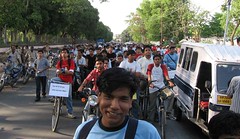
From Anti-reservation rally of IITK students


Rally-0121
Originally uploaded by amathad.


This is the picture that I received through the alumni association yesterday. IITK students held a bicycle rally protesting against the 'proposed hike in reservation'.

Comments invited


, , ,

Thursday, June 01, 2006

Some good news from london...

I saw this story in yesterday's Hindu.

A ground-breaking ruling by the House of Lords, Britain's highest court, has obliterated the traditional and somewhat perverse distinction between the
home-maker and the breadwinner on grounds that a marriage must be regarded as an alliance of "equal partners" — and that the contribution of the partner, who
stays home to raise the family, is no less important than the one who brings
home the bread.

Wow! This is fabulous news. This means the housewives can claim equal share of the money that the husband earns during their marriage.

, , ,

Why do you need enemies when you have friends like me?

This is a post that is irrelevant to the nature of this blog but I think circumstances dictate it.

People have accused me of being very stubborn and narrow-minded over certain issues. The thing is that I am willing to listen to you as long as you are willing to make logical and rational arguments. If you do not want to debate or you make unsubstantiated statements, you really cannot expect me to accept them as the gospel truth.

In a debate/argument, both/all the participants have a duty/right to put forth their views. If they think my views are illogical, they cannot just say that and be done with it. Say it only if you are willing to fight me on that. Otherwise, I do not see the point of you getting angry and getting all worked up when I do not accept them.

I have been accused of trying to force my views on others. Well, I do that sometimes. If I did that all the time, I do not think there would be many who would like to be with me. In fact, by my standards, I hardly ever pontificate. It really does happen rarely. People who have lived with me can testify to that.
Secondly, I do have quite strong, unimpeachable opinions about certain things but most of the time, my views are very flexible. If you know how argue with rational thoughts and ideas, you might end up winning me over to your side (if I am not there already). But most of the time, all I hear is stupid generalisations and statements without backing. And when they get frustrated when I brush aside their statements with statements (without backing) of my own, they start shouting and get all worked up. Well, that doesn't harm me at all. Also, I don't care to explain satire to each and every person. If can't understand satire/irony, then I suggest you go somewhere else.

I believe in certain things and I usually do not let my personal beliefs get in the way of my judging people. I am friendly to many but respect few. But even those I respect do not necessarily share my point of view. In fact, I am really a kind of a radical (never thought I would say that about myself, though. But going by how close-minded the rest of the world seems to be, I have to term myself a radical).

I am always at loggerheads with one of my friends. He and I never agree on almost everything. But I respect him and hopefully, he respects me too.

Believe me, it is _not_ personal. If I critique you here, it does not mean that I think you are a moron (unless I explicitly say so).

PS. This is obviously aimed at a particular person but I thought that there was a need to clarify to all my friends who read this blog.

PPS. This would be one of very few personal words that I would put up on this blog. Now, I will get back to critiquing the world around me.

Wednesday, May 31, 2006

Letter by IITK faculty

If you havn't seen it already, check it out here.
Apparently, 125 members of the faculty have signed this letter. The blog post I have linked to does not provide us with the names of the faculty who have signed it.
I have no problems with faculty being against reservations. But what I have a problem is with this letter. It is quite simply a no-brainer. I will try to pick this letter apart.

The undergraduate students of IIT Kanpur do not usually, or even often, come from wealthy and privileged backgrounds. The vast majority come from the smaller metropolises like Kanpur, Patna and Allahabad, or cities like Bareilly, and the moffasil towns and villages of Uttar Pradesh and Bihar. A typical example is the late Satyendra K Dubey, an IITK alumnus, whose murder in 2003 while working on the National Highway project got national media attention. He came from a small village in Bihar.
Uh? This is quite frankly bad information, at worst, a lie. Most of the students who get into IITs are from the metros. Many go through a year of two of intensive coaching at coaching centres in cities/towns like Delhi, Kanpur, Patna, Kota, etc, etc. In fact, the coaching centres has played on the minds of the setters of JEE for a long time. Read this article by a prof who points out some of the debates that surround JEE. JEE was purposefully made easier to defeat the unquestionable influence of the coaching centres and to make it easier for people who did not go through coaching to get into IITs. Are none of the "125" members of the faculty who signed this letter not aware of this? Unless, they just ignored to mention this as it would harm their argument about how it is "dedication and talent" that gets people into IIT and not "wealth, privilege or birth".
Based on this premise, the article goes on to say -
Into such an environment the introduction of privileges accruing only to members
of particular castes would be a travesty.
But it is only the privileged (in terms of having the money to pay for coaching centres or living in the cities) or the geniuses (who are a few people for whom coaching is not required) that gets people into IITs!
Further, with no objective criteria yet laid down for defining backwardness,
such privileges will seemingly be granted in perpetuity.
What? Are they not aware of the 11 guidelines that Mandal commission recommended to define backwardness? Even if you consider those guidelines to be contentious, this statement does not make any sense to me.
Backwardness is not determined by caste alone. It is clear for all to see that
other factors like poverty, region and gender have greater adverse impact on the
chances of a person becoming an engineer or a doctor. It therefore seems to us
that, except in electoral terms, purely caste-based reservations make no
rational sense.
Agreed. Does this mean that you are ready to welcome reservation policy that would incorporate all these factors? If so, how would this fit in your crib about merit?
Rather it is to argue that the best institutions in India should be the
preserves of excellence, with proven performance as their only selection
criterion.
Translation: IITs are an elitist institute where we don't want the scum of India to populate.
Proven performance, indeed! There is only parameter that is used to determine this proven performance and it is JEE. Performance in one exam [equals to] proven performance.
Rather it is a necessary strategy for ensuring that developing India soon
catches up with the developed nations of the world, so that, in the long run the
IITs are instrumental to raising the standard of life of all Indians, and shine
forth as exemplars of development and emancipation in an environment of extreme
challenges.
Lol! IITians have mostly contributed to the development of the mahan Silicon Valley of the US of A. I really wonder what the contribution of IITians is to the technological advancement of this country. Don't point to the IT industry.

Even if Government insists on affirmative action programs for IITs...

ie, if push comes to shove...
we are sure that the IITs can be trusted to evolve and implement such programs by themselves.
Why havn't they done that so far? Why does the government come up with a draconian measure before they come out saying, "don't worry, we can do this ourselves. You don't have to force us to."
After all, IIT Kanpur has had an exemplary record of implementing the SC/ST
reservation in a supportive and pro-active way that became a model for all IITs

Yeah, they really have been a model of creating a very wonderful atmosphere for SC/ST students.
It would be most disastrous to impose a 27.5% quota on the IITs in an ostensibly
"fair way" by increasing the number of seats. This would mean rapidly increasing
the seats substantially.
Yes, that is true. IITs would have to increase their seats if the government goes ahead with its proposed compromise.
In recent years we have doubled our intake.
This is news to me. As far as I know, the intake of students has increased by about 100-150 per IIT. That is like an increase of 35% at the most. Not sure about the medacity of this statement.
So the IITs are already short of faculty, as few applicants meet our exacting
standards of academic excellence.
So, if the IITs are already short of faculty, why did they increase their intake two-fold. Of course, their arms could have been twisted by the government. Interestingly, they did not raise any voice against the proposed scheme to create 11 new IITs. If they cannot find faculty for the current IITs, how are they going to create those institutes with quality faculty? And wouldn't increasing seats and increasing the number of IITs dilute the quality and image of the IIT brand, much like the water mixed with milk by the doodhwallahs? Why didn't they raise a hue and cry over that?
If a sudden increase of faculty is imposed on us by a drastic increase of seats, the entire academic standing of the IITs will be compromised, and they will go the way of so many universities before them.
True. The logistics of increasing seats to appease the striking medicos does not make sense to me. But is this an argument against reservations?

The entire mail contains little, if any, arguments against the reservation policy. Apart from cribbing about 'merit', there is no substance. And it is full of grandeur and impassionate pleas to not 'hurt' the IITs that are almost melodramatic. Sample this -

It will have devastating consequences to the culture of excellence cultivated
over half-a-century by generations of dedicated and knowledgeable teachers and
tens of thousands of brilliant students of all castes, creeds and linguistic and
ethnic groups.

[...]

because the admission is blind to caste and indeed to every other criterion except ability

[...]

Rather it is to argue that the best institutions in India should be the preserves of excellence, with proven performance as their only selection criterion. Such institutions serve to develop the “seed-corn” of the nation which can then be planted elsewhere to make the whole nation grow in strength and prosperity. Therefore think not of IIT students in terms of their castes, but of them only as India’s best hope, as the future leaders of India who have been nurtured in an environment where only excellence matters, not caste, creed or ethnic origin.

[...]

ensuring that developing India soon catches up with the developed nations of the world, so that, in the long run the IITs are instrumental to raising the standard of life of all Indians, and shine forth as exemplars of development and emancipation in an environment of extreme challenges.

[...]

only very few other than the IITs can train students in the highly specialised engineering and scientific skills required in India if it is to become a developed country

[...]

At this moment, when the entire nation is on the verge of take-off to becoming a major economic power, when multinational companies are shifting their research and development centres to India because of the vast technical manpower here, let us not play with these great institutions and cripple them in the hour of their greatest utility.

[...]

do everything you can to preserve the IITs for the future generations of India and, indeed, for the very future of our country

[...]

So let them remain free to flourish as the standard bearers of Indian science and technology which was, and should remain, their primary purpose.

Ugh!

IIT professors are quite intelligent folks; they are probably the very best in India. So, this letter really comes to me as a great surprise. I expected it to contain some reasoning as to why they are opposed to the proposed reservations but instead I find nothing but wild statements and unrealistic (and untruthful) harping on merit. In essence, this letter is an insult to intelligence and I wonder who are these professors who have signed this letter.

I suspect the hand of the one man who is capable of all this melodramatic and impassionate words. To IITKians, that man's performance in Hall 4 would be quite fresh in memory.

My alma matter disappoints me. Now, I will go out and cry. :`(

Hat tip -- Abi

PS. Badri also has criticised this letter.

Technorati tags: , , ,

Tuesday, May 30, 2006

Read this post by Abhaya.


Abhaya argues against reservation. Ironically, he inadvertently makes a case for reservation!!


Technorati tags: , ,

,

Similarities between Narmada and Plachimada

1. Both are places where the contentious issue involes water.


2. Both involve Aamir Khan. Aamir Khan is the brand ambassador for Coca Cola, the company that is sucking Plachimada dry besides creating humongous pollution, and the ambassador for the displaced people because of the Sardar Sarovar Dam.


Amazing, how the media does not highlight this inconguruity about Aamir Khan. How can he create ads for such a company and also be a "concerned citizen" of India? Hypocrisy? maybe. Ignorance? perhaps. No ad money from Sardar Sarovar Dam Project? *shrug*.


If Aamir is really concerned about the people who dont have a voice, perhaps he should stop his double standards. I still appreciate his coming out in support of NBA but hope that he wont stop there and that he would be a more informed and concerned citizen.


Technorati tags: , , , ,

"Why should I suffer for the misdeeds of my anscestors?"

A very common and understandable sentiment. On the surface, it does seem unreasonable to "punish" somebody because of crimes committed by someone else. Even though, one might claim to not see the lower caste people as inferior and would not discriminate against them, the policy of reservation does not reward you for that. The policy seeks to make amends for crimes committed by ones forefathers. Just because your father committed a murder does not mean that you ought to be put in jail for that crime, should you?


One might consider this to be a strong case against reservations by arguing that it "punishes" the innocent.


Why then do you expect to inherit property and power that your ancestors had? Why should the sons of businessmen inherit their father's business and enjoy the foundation, which would have required much hard work, laid out by his ancestors? Is there a logical reason as to why one considers inheritence in this biased manner?


Secondly, does it really "punish" an individual? As in, is the policy framed so as to take out vengeance on a particular person? Arguing against a social policy aimed at communities at large from a personal standpoint makes no sense to me.


Thirdly, to deny the influence of one's ancestors on one's current status in society is illiogical. One is obviously influenced by his/her parents and you are dependent on them for 15 to 21 years of age (under normal circumstances). So, your current status is dependent on your parent's hard work. Assuming you were the exact same individual but were born in different environments - a brahmin family, a dalit family, an orphan, etc, you would be in different state (economic and social) at your age. Can you deny that?


Technorati tags: , ,

Thursday, May 25, 2006

Some more on reservations

In this whole reservation issue, I have found that there are really a multitude of views.


1. Just plain anti-reservation - These folks think reservation is a bad policy in principle. They want all types of reservations to be repealed and that people should be selected on 'merit'. These people are most likely to be libertarians.


2. Anti-reservation because reservation havn't achieved their goals - These people believe that reservations have not much improved the socio-economic condition of the people and therefore, it is time to think of a better policy. So, they demand that reservations be done away with.


3. Anti-reservation because of political cynicism - "It is vote-bank politics" and the opportunistic politicians just want to get political mileage from this issue.


4. Anti-reservation because of stale data used by Mandal Commission - This viewpoint basically stems from the idea that the 1931 census is not the right indicator of 'backwardness' 75 years later.


5. Anti-reservation because it will dilute the quality of our educational institutes - The belief is that people who come through reservations do not really "deserve" the seat and they are not able to cope up with the demands of higher education. So, is reservations is increased, it will lead to more and more students getting an education they don't deserve.


6. Anti-reservation because it is reverse discrimination - The very nature of reservations makes it discriminatory. It divides people into RC and GC. RC and GC people do not usually mix; they form separate groups.


7. Pro-reservation because reservation has made a difference - If today, there are dalits in government jobs and getting higher education, it is most probably because of reservations. It has given them the first thing that is required for social upliftment - access to higher education.


8. Pro-reservation but are not comfortable with implementing such a major policy without proper research - Basically, this view demands that there be a proper survey of the current situation of the communities and then implement a reservation policy based on this research. The government still have a year to do this before the OBC reservations come into effect.


9. pro-reservation because they don't want to be categorised with people who make bigoted statements - this is a question of being uncomfortable with being slotted with undesirables. One doesn't want to attributed with bigoted views just because anti-reservationists are being equated to casteist bigots (because they are the most vocal and most numerous).


10. Anti-reservation because they feel people with view no. 9 are tipping the scales. They just want to "win" this battle. They feel this is a moral and philosophical war going on and they have an obligation to win it for the good of the nation.


11. The confused - they feel reservations is the right policy but side with anti-reservationists because of a combination of views no. 2, 3, 4. One might confuse them with the total anti-reservationists but if you dig a little deeper, you find that their view is really more complex.


12. The sophisticated - They look west for inspiration. They profess to believe in Affirmative Action and not reservation. They stress that the two are different. And that affirmative action is the step in the right direction. And not reservations.


13. Anti-reservation because primary education is more important - The notion that reservations would be the be all and end all of all educational reforms and that primary education would be neglected because of this reservation policy. Also, how would the really needy people be able take advantage of reservation is higher education if they are unable to get a proper primary education??


These are the most predominant views that I have found among people. I might have missed a few but generally I have found people to have a combination of the above views.


My views are essentially 7 & 8.


Today I got a mail from a roomie which was basically a forward that said that there was going to be a peaceful protest march in Bangalore on the 27th. The mail fails to mention exactly what the march is a protest for. The only vague implication is that it is "against quota". The mail exemplifies the attitude towards this issue by the majority of the population/media. Either you are with us or against us (reminds of George W. Bush). Is the protest against reservations completely or just the reservations for OBCs or against the government implementation of this policy without proper research? One might never know. Yet, I am sure a lot of people, with diverse views on this issue, would join them and register their protest.


What I am against is the extremely narrow view of this issue as a battle between two camps. And I am sad to see that some really intelligent people are entrenched into this. A complete lack of coherence amidst the anti-reservation crowd just makes it impossible to judge them. Some of them are not entirely wrong and I agree with some of their opinions but quite a lot of them are disgusting and makes me want to block them out.


So, I end up by saying that I support reservations, though I think it needs fine-tuning and participation of the people. If you leave it to politicians, it would never happen.


Technorati tags: , ,

Tuesday, May 23, 2006

Responses and my counter-response...

My post on reservations has got some of the usual responses.


rc aka RealityCheck seems to think that it is the SC/STs who are oppressed. OBCs are not apparently. Though he does make some pertinent points regading the data that Mandal commission used to create the OBC classification, he does make some atrociuos statements in his blog. Unlike SC/STs, OBCs are powerful politically, economically, and socially. Plus, I am really appalled at the amount of spite he shows for 'Madrasis' in this sentence -- These madrasis are so insistent on this issue that I am helpless. Interestingly, he looks to 'westerners' for his reality checks. Lol. What a dose of realitycheck ! like only a westerner could give us. No wonder he is gender confused... :)


HungryAndRestless calls for all IT and call center employees to strike. His/her blog has nothing but two posts that provide no logical reasoning for protesting against reservations. Just some pithy phrases about how important it is to hurt the government.


Abhinav Gupta seems to be a parrot (or a plagiarist) who seems to copy-paste the same line as a comment on a lot of blogs!!! Why? Nothing original to say? Too speechless that there are people who consider that any policy issue needs to be discussed before making a verdict?


Rahul seems to think that nobody thought of reservation for OBCs before. I think he has never heard of a state called Tamil Nadu and Karnataka. In TN, 69% of the seats are reserved.


Shravan makes the "logical" statement that those medicos who come through reservations would kill their patients. I would suggest him to remove his head from his sphincter.


Confused links to this story and quotes this line -- "There are some 3.5 million Dalits in government jobs, about 125 MPs, and hundreds of MLAs. There are about 68,000 Dalits in Group A services." But somehow forgets to mention the following line from the same story!!! "Outside the regime of reservations, say in the private sector, there are hardly any known Dalits in corporate boardrooms, acting in Bollywood, or speculating markets at stock exchanges, to say nothing of a publicly traded Dalit-owned company." and this -- Charlie, who completed his PhD at IIT Kanpur and by his own admission interacted with several "reserved quota" students, says: "I do not forsee any remarkable decline in standards at IITs or IIMs." Talk about selective quoting!!! He goes on to rant about how "the intended purpose of reservation is to benefit few so that the trickle down effect improves the general lot of the community" based on this data.
He also links to this hindu story and selectively points out that "less than 40 students from the forward classes will get into MBBS this year". If you read that story carefully, it says that people who come under reserved category are competing under general category (remember, TN has 69% reservation) and generally beating the forward castes to the seats even in the general category! The article ends with this conclusion -- Strict enforcement of the 'creamy layer' policy as set out by the Supreme Court could see that the benefits of the reservation reached both the urban and rural poor." Confused somehow fails to mention this. Reservation policy in TN definitely needs a revisit.


Ankan points out that the Mandal Commission report was made in 1978 and that it is based on 1931 census. Actually Ankan, the report was filed in 1980. The commission was commissioned in 1978. And yes, I am aware of this fact. But does that really give a reason for doing away with reservations or does it say that we should logically have a census that collects data based on the parameters that Mandal commission suggests? Plus, if "things havn't changed a lot in 55 years of reservations", then can we extrapolate and say that things have not changed a lot in 75 years (20 years of which were without reservations)? It seems unfair and contradictory when you say that reservations have not really helped a lot to improve the status of the SC/STs in 55 years and also dismiss the 1931 census data as stale because it is too old and is not a right indicator of socio-economic status because it has changed too much!! Think long and hard about it...


Most of the anti-reservation arguments have been a touch on the cynical side. "This will lead to rush getting your caste classified as OBC". Why? "Because it is easier to get though the reservation quota." The reservation quota is 27% for OBCs and OBCs already constitute 52% of the population. Considering the SC/STs to be 22.5 % of the population, the general category would constitute about 25% of the population and they get 50% of the seats to compete for. But shouldn't the competition for the general category seats to be lower, logically? Interestingly, it is the reverse. That suggests that the upper caste people somehow manage to create more competition amongst themselves even though they have more number of seats available to them (proportionately and numerically)! That logically says that economic/educational status of the upper castes is pretty high, which is true. Now if we take the cynicism of the first statement to its logical end, we would end up with more and more percentage of the population competing for the same percentage (27%) of seats, and lesser and lesser percentage of population competing in the general category. Wouldn't this actually reduce the competition for the upper castes? Oops, looks like the reservation would actually end up helping the upper castes!!!


"Students who get seats through reservations are no-good and undeserving. They wont be make good doctors or engineers and get undue benefit which they do not deserve." Ahem! For one, I will point to this article again, which seems to suggest that people who belong to backward castes are actually garnering seats in the general category. That is amazing. That suggests that TN is ready to pull out the OBC status on some communities. I like the way the article attributes this phenomenon to "academic maturity", not merit! Because merit, as we all know, cannot really be measured objectively.


Another common rant is that most/all of the OBCs are really rich and politically powerful groups that really do not need the "crutches" of reservations. I agree that there are some OBCs that are indeed not really backward. But I wonder how someone can make this blanket statement based on a few (and they can name only a few) castes? Do they have the data on the socio-economic statuses of over 3000+ castes and communities? What is the percentage they used to conclude that 'most' of the OBCs do not deserve reservations?


For all those who are anti-reservations, I have these questions -
1. Do you believe that the caste system is a social evil and there is an urgent necessity to bring social justice?
2. If you do, would you work towards eliminating this lineage-based caste system by marrying people from other castes? If you are already married, would you pledge to marry your sons and daughters to people of other castes?
3. Would you be willing to have a more meaningful and democratic debate on the reservation issue or are you going to shout slogans and go on hunger strikes to make the government meet your demands?


The reservation issue is a complex one and not one that can simply be categorised as being either for or against. That simple dichotomy never works, except in the books of the bigoted. It is not a case of improving primary education or reservations. And there is definitely the issue of opportunistic politics that is detrimental to the policy but the solution to this is not to get rid of reservations but to engage/force/monitor the government to be true to the Mandal commission guidelines regarding inclusion/exclusion of castes in the OBC category. But the larger goal is to work towards a society where people are not ostracized/discriminated on the basis of caste.


Technorati tags: , , ,

Site Analytics

Powered by Blogger

eXTReMe Tracker

Powered By Blogger